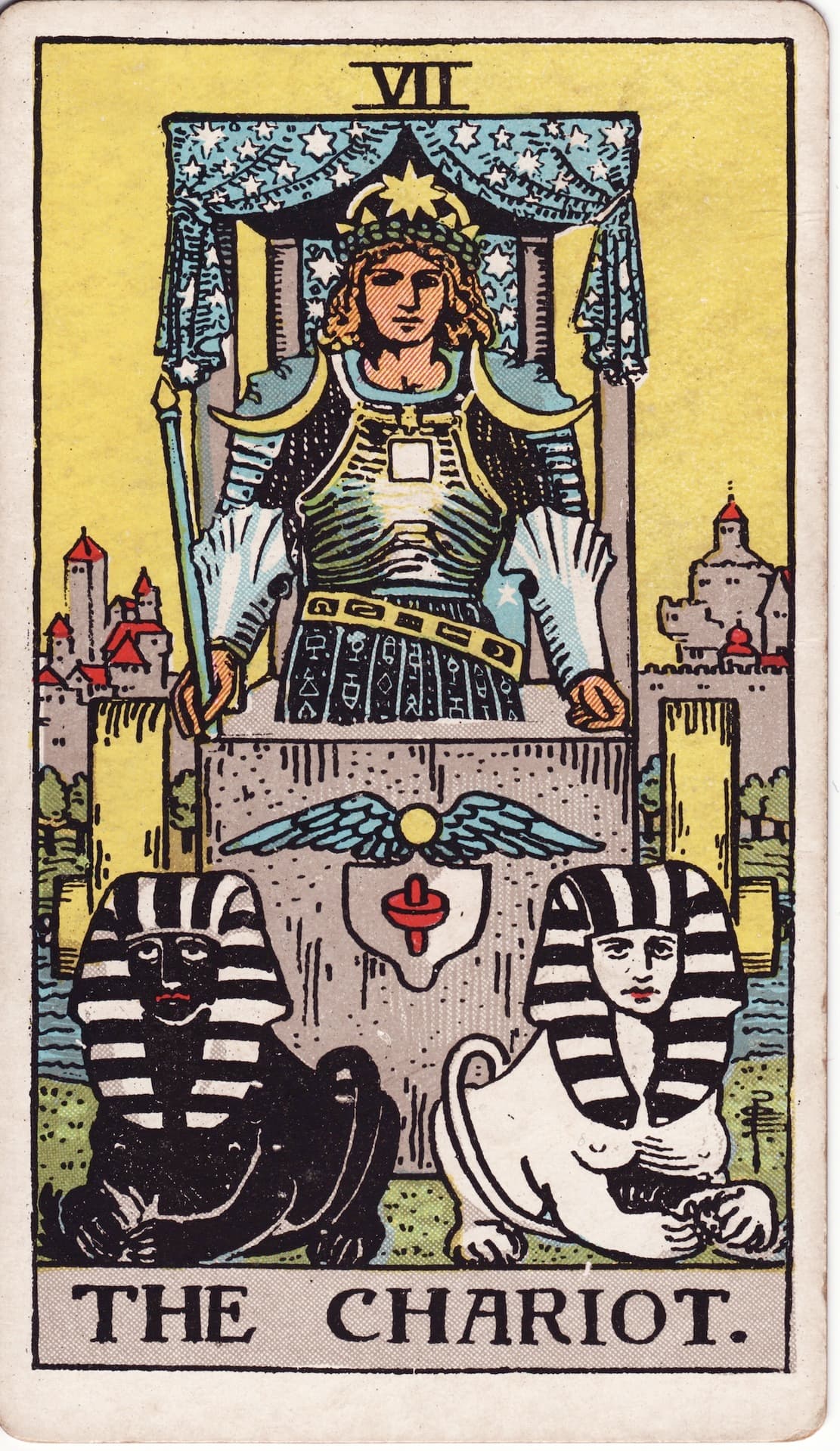
The Chariot
- Succour
- providence
Divinatory Meanings
Succour, providence; also war, triumph, presumption, vengeance, trouble.
Waite's Symbolic Description +
An erect and princely figure carrying a drawn sword and corresponding, broadly speaking, to the traditional description which I have given in the first part. On the shoulders of the victorious hero are supposed to be the <i>Urim</i> and <i>Thummim</i>. He has led captivity captive; he is conquest on all planes—in the mind, in science, in progress, in certain trials of initiation. He has thus replied to the sphinx, and it is on this account that I have accepted the variation of Éliphas Lévi; two sphinxes thus draw his chariot. He is above all things triumph in the mind. It is to be understood for this reason (<i>a</i>) that the question of the sphinx is concerned with a Mystery of Nature and not of the world of Grace, to which the charioteer could offer no answer; (<i>b</i>) that the planes of his conquest are manifest or external and not within himself; (<i>c</i>) that the liberation which he effects may leave himself in the bondage of the logical understanding; (<i>d</i>) that the tests of initiation through which he has passed in triumph are to be understood physically or rationally; and (<i>e</i>) that if he came to the pillars of that Temple between which the High Priestess is seated, he could not open the scroll called <i>Tora</i>, nor if she questioned him could he answer. He is not hereditary royalty and he is not priesthood.